South Georgia – The 60th Anniversary Of The Queen’s Coronation stamp issue!
VN:F [1.9.1_1087]

Her Majesty Queen Elizabeth II acceded to the Throne on 6th February 1952 following the death of her father, King George VI. However the 1 day celebration of the Coronation required a further 16 months of careful preparation.
(read more)
South Georgia – Star Trails!!
VN:F [1.9.1_1087]
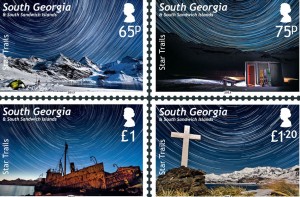
South Georgia is an ideal location for astrophotography as the nearest light pollution is over 800 miles away. On a clear winters night with the sun well below the horizon the quantity of stars is simply breath taking. Unfortunately a cloudless South Georgian night is a rarity.
(read more)
published April 21st, 2013
Mountains – Stamp Issue
VN:F [1.9.1_1087]

A chain of alpine summits, amongst the highest mountains in the British territories, these are the icy jewels in the crown with unclimbed peaks that have been unattainable for so long. There are mountains that might take a week to climb from the shore and sometimes rebuff much longer efforts with the foulest weather and fierce storms that can lend fear and despondency into the very soul of even the most determined mountaineers.
(read more)
published October 27th, 2012
South Georgia and South Sandwich Islands Marine Protected Area – Stamp Issue
VN:F [1.9.1_1087]

During the last two hundred years human activities have had a detrimental influence on the marine environment through over-exploitation of natural resources, exploitation of sub-sea minerals, pollution and more recently climate change. Climate change now threatens the rich biodiversity of the marine environment due to temperature changes and ocean acidification.
(read more)
published September 29th, 2012
Her Majesty Queen Elizabeth II, Diamond Jubilee-Stamp issue
VN:F [1.9.1_1087]

To celebrate a remarkable 60 years of Queen Elizabeth II as Monarch of the United Kingdom of Great Britain and Northern Ireland and of Her other Realms and Territories we are delighted to confirm the issue a special set of new stamps and a souvenir sheet from South Georgia and the South Sandwich Islands.
(read more)
published April 18th, 2012
South Georgia – WWF Seabirds- Stamp issue
VN:F [1.9.1_1087]

This stamp issue, produced in association with World Wide Fund for Nature (WWF), recognizes some of the lesser-known species of seabird breeding on South Georgia. The species depicted are part of the rich biodiversity found in South Georgia’s unique environment. WWF is one of the world’s leading conservation organisations who work towards conservation and sustainability.
(read more)
published February 7th, 2012
South Georgia’s Shallow Marine Life Stamps
VN:F [1.9.1_1087]
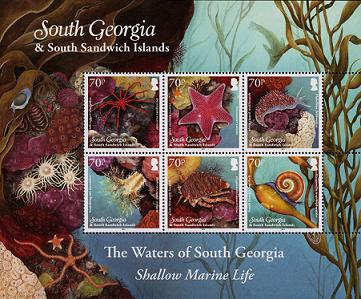
Shadowed beneath South Georgia’s rugged mountains and glacial valleys lay a rich and colourful seascape of plants and animals. This shallow marine environment has received surprisingly little attention since it was first studied during the Discovery Expeditions in 1925. As South Georgia is situated just south of the Polar Front, where warmer waters from the north meet colder Antarctic water from the south, the region is home to a unique assemblage of South Atlantic and Antarctic animals.
(read more)
published October 7th, 2011
South Georgia’s Frank Wild Stamp Issue
VN:F [1.9.1_1087]

John Robert Francis Wild C.B.E. known as Frank, was one of the most outstanding Polar explorers of the ‘Heroic Age’. He undertook five Antarctic expeditions under the leadership of Captain Robert Falcon Scott, Sir Ernest Shackleton and Sir Douglas Mawson and was the only man to experience six gruelling winters in Antarctica. Frank Wild is one of only two people to be awarded a four bar Polar medal and each pair of stamps in this issue represent the expeditions for which he was awarded a bar.
With the death in 1922 of Shackleton, his beloved leader and friend, and his decision to emigrate to South Africa, the reputation of this extraordinary man was largely forgotten. (read more)
published October 5th, 2011
South Georgia – Frozen Planet Stamps
VN:F [1.9.1_1087]

Produced by the BBC’s Natural History Unit, Frozen Planet is the most ambitious series on the Polar Regions ever undertaken.
For four years, camera teams braved temperatures down to -50 degrees C, 200 mile per hour katabatic winds, midnight sun and long dark polar nights to capture the essence of these remote and highly seasonal ends of the earth.
More than 2300 filming days were spent in the field, by small crews working in the most remote corners of Antarctica and across the Arctic. The aim was to take the viewer on a journey through the Polar Regions – north and south – some of the greatest, least explored wildernesses on the planet. (read more)
published July 27th, 2011
South Georgia Petrels Stamps by the artist John Gale
VN:F [1.9.1_1087]

There are 125 species of tubenose birds, which include the petrels and albatrosses. The four species illustrated on this set of stamps represent three species of fulmarine petrel and one species of diving petrel. These birds inhabit an oceanic environment, feeding on the abundant food supply present in the Southern Ocean. They nest and breed on many islands in the Southern Ocean, including South Georgia, the three species of fulmarine petrel also breed on the South Sandwich Islands.
60p – The southern giant petrel Macronectes giganteus along with the northern giant petrel Macronectes halli is the largest of the fulmarine petrels. It is an exceedingly powerful and aggressive bird, but none the less beautiful. The vulture of the region, the males feed on the carcasses of seals and penguins and it is a truly remarkable site watching them feed in large numbers. Dominant birds will repeatedly fight and knock other birds out of the way in order to get access to a carcass. Meanwhile, smaller skuas patiently wait at a safe distance sneaking any opportunity to dive in and grab a morsel of food while the giant petrels are squabbling. While drawing a dead giant petrel found on South Georgia examination of its bill revealed how incredibly sharp and powerful the cutting edge is, the perfect instrument for tearing flesh.
(read more)
published June 27th, 2011
South Georgia – Wrecks & Hulks stamps
VN:F [1.9.1_1087]
There are over sixty wrecks and hulks around South Georgia, most of them scuttled and sunk, some still visible. Except for a submarine and two modern fishing vessels nearly all took part in the sealing and whaling industries.
The South Georgia wrecks and hulks fell victim to uncharted waters, unpredictable weather and – at the end – to the decline of the whales. Catching one’s eye in the vicinity of the former whaling stations some appear now to be taking a long winter’s rest. To best portray this solemn sleep, all images were taken in winter at full moon.
The two riveted, iron-hulled, three-masted sailing vessels Brutus and Bayard served as coaling hulks: Brutus (built 1883 in Glasgow, 76 m long, 1686 tons) in Prince Olav Harbour, the Bayard (built 1864 in Liverpool, 67 m long, 1335 tons) in Ocean Harbour. At the beginning of South Georgian whaling, prior to World War I, such cargo vessels that were exclusively propelled by wind became redundant world-wide, and were cheap to buy (read more)



 Loading...
