It might be summer in some areas but Australia issues a Snow skiing stamps this week
VN:F [1.9.1_1087]
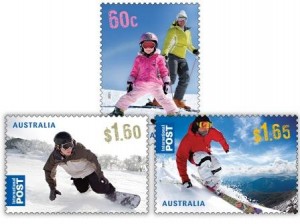 Snow skiing had its genesis in Australia 150 years ago, at the Snowy Mountains settlement of Kiandra, New South Wales. A small group of Austrians and a Norwegian, goldminers at the settlement, were behind the activity. The club that developed was called the Kiandra Snow Shoe Club, later renamed the Kiandra Pioneer Ski Club. This is thought to be the first and longest-surviving ski club in the world, established the same year as the first club in Norway, although the claim is not universally supported.
Today, skiing and snowboarding are undertaken in three Australian states: New South Wales, Victoria and Tasmania. Australia’s 14 alpine resorts are of varying size and sophistication, the most popular being Perisher, Thredbo, Mt Buller, Hotham and Falls Creek.Victoria is home to a total of eight resorts, some of which offer only cross-county skiing; New South Wales is home to four; and Tasmania to two. Between them, New South Wales and Victoria attract the lion’s share of skiers and snowboarders, Tasmania representing around just one per cent of the market.
The three stamps in this issue represent the (read more)
published July 22nd, 2011
Living Australian Photography Competition sees top five on new stamp issue
VN:F [1.9.1_1087]

Australia Post is releasing a stamp issue featuring the top five finalists from a national photography competition initiated by the Australia Day Council of New South Wales (ADCNSW). The Living Australian stamp issue includes five 60 cent stamps and will be available on 5 July 2011.
In 2010 the ADCNSW with the support of Australia Post encouraged Australians to explore the theme of “Who We Are” as a nation, by showcasing how they live as Australians every day through the creative medium of photography.
The response was overwhelming with 3,350 images submitted in the categories of Community; Pride; Family and Mates; and Freedom. Photographic subjects ranged from the wide brown outback to the golden beaches and cosmopolitan cities. All entries, finalists and winners can be seen on the website www.AUSSIEVAULT.com.au .
(read more)
Australian Bush Babies Stamps
VN:F [1.9.1_1087]

Some of Australia’s most popular native baby animals are featured in this delightfully illustrated stamp issue. The animals featured on the stamps are a bilby, dingo, kangaroo, koala and sugar glider.
This issue also includes five stamp and coin covers, each depicting a different baby animal. These special covers feature an exclusive $1.00 aluminium-bronze coin from the Perth Mint, which are only available as part of this product. The stamp and coin covers will be available at regular intervals over a six month period.
The Bilby (Macrotis lagotis) is a nocturnal marsupial with distinctive rabbit-like ears, greyish fur and a beautiful bushy black tail with a white tip. It survives on a diet of seeds, grubs, bulbs, fruit and insects. Bilby babies stay in the pouch for about 80 days.
(read more)
Australia Post unveils ‘post office of the future’
VN:F [1.9.1_1087]
Australia Post is excited to announce plans for a ‘post office of the future’, an innovative store showcasing a range of new services to offer customers greater access, convenience and choice in the way they transact with Australia Post.
The store will offer a dedicated area for online shopping where online traders can fulfil their postage needs, a travel services zone and a private lounge where customers can complete more complex financial and identity services transactions.
In another first, the store will have a 24/7 zone for customers to pick up parcels, vending machines where customers can buy stamps and packaging products as well as weigh and send parcels at any time that suits them.
(read more)
Royal Australian Navy Stamp Issue 1911-2011
VN:F [1.9.1_1087]

Marking the 100 years of the Royal Australian Navy this ‘then and now’ stamp issue features the Australian Navy’s first flagship, battle cruiser HMAS Australia (I) and modern missile frigate HMAS Sydney (IV).
From settlement in 1788 to 1859, Australia depended on units detached from the Royal Navy based in Sydney to provide naval defence. In 1859, Australia was established as a separate British Naval Station and, until 1913, a squadron of the Royal Navy was maintained in Australian waters. This Australian unit was to be paid for and controlled by the Australian Commonwealth and was to be eventually manned by Australian personnel.
(read more)
published June 26th, 2011
Christmas Island Crabs stamp issue from Australia Post
VN:F [1.9.1_1087]

The land crabs of Christmas Island are remarkable for their abundance and the role they play in the ecology of the island’s rainforest.
Through their scavenging activities they recycle utrients locked in fallen leaves. Their burrowing tills the soil and their browsing on tree fruits and shoots is probably an important factor in determining forest composition.
Twenty-three land or freshwater crabs have been identified on the island.
Red crab Gecarcoidea natalis (60c)
The sight of the red crabs on their annual breeding migration is one of the outstanding natural spectacles of the world.
(read more)
published June 20th, 2011
Australia Post’s Icebergs stamps
VN:F [1.9.1_1087]

Literally meaning ice mountain, an iceberg is a large piece of ice formed from freshwater that has broken off from a snow-formed glacier or ice-shelf and is floating in open water.
The largest recorded icebergs have been carved, or broken off, from the Ross Ice Shelf in Antarctica. Iceberg B-15, when photographed in 2000, measured 295 km long by 37 km wide, with a surface area of 11,000 kilometres. Icebergs are generally described by shape and include tabular, dome, pinnacle, wedge and dry-dockan eroded iceberg resulting in a “hole”.
Including all its islands and ice shelves, Antarctica is nearly twice the size of Australia, covering 13,661,000 square kilometres. The Australian Antarctic Territory is 5,896,500 square kilometres, or 42 per cent of the region. (read more)
published June 14th, 2011
“Capturing the Moment” of the Royal Wedding commemorated by the Australian Post
VN:F [1.9.1_1087]
 Just days after the historic Royal Wedding of Prince William and Miss Kate Middleton, Australia Post is delighted to commemorate the event with a sheetlet of stamps that capture so beautifully the happy couple on their wedding day.
The sheetlet is able to be released within days of the wedding due to special technology that allows the image to be uploaded into a Royal Wedding stamp template, pre-approved by Buckingham Palace.
(read more)
Farming Australia
VN:F [1.9.1_1087]
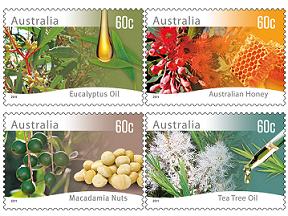
The Farming Australia native plants stamp issue represents four of Australia’s largest native horticultural industries and promotes the importance of Australia’s commercially cultivated industries.
The eucalyptus oil industry, which began in 1852 in Victoria, has been called the first truly Australian industry. Today Australia accounts for only 10 per cent of the total world production, but it is regaining some of the market share for medicinal oil lost to China. Australian oil derives from the Blue Mallee, grown mainly in central Victoria with some production in NSW. Eucalyptus oil has a wide range of industrial and medicinal uses. (read more)
Australia Post warns of “Track and Trace” Phishing Email
VN:F [1.9.1_1087]
Australia Post is alerting customers to an unsolicited phishing email advising them that their mail article has arrived. These emails include references to Australia Post and include items like their logo, which may mean that some customers are unsuspecting victims of these scams.
They recommend customers remain alert of unsolicited emails from organisations requesting personal or financial information. Australia Post does not send emails requesting you to confirm, update or disclose your confidential financial information. (read more)
Dame Nellie Melba (1861-1931)
VN:F [1.9.1_1087]

This stamp issue commemorates the 150th anniversary of the birth of Australia’s first international “superstar”, soprano Dame Nellie Melba (1861-1931).
Melba was born Helen Porter Mitchell at Richmond, Melbourne and made her debut at the Melbourne Town Hall in 1884. After an audition in Paris, Mitchell adopted the name Melba after her home city, and made her debut on the European opera stage in Brussels in 1887. After a triumphant season at Covent Garden in London the same year, Melba was feted all over Europe. She became best known for her interpretation of Mimi in Puccini’s La Bohème which she premiered at the Royal Opera House in London in 1899.
Her glittering career continued until the 1920s. In 1927 Melba was appointed Dame Grand Cross of the Order of the British Empire (G.B.E.). Suffering ill health, she returned to Australia in early 1931 and died in Sydney a few weeks later.
(read more)



 Loading...
