Australia Year of the Rabbit stamps
VN:F [1.9.1_1087]
 The Rabbit is the fourth sign in the Chinese zodiac and symbolises creativity, compassion and sensitivity. In the Chinese story of the Jade Rabbit, three sages transformed themselves into pitiful old men, and begged for food from a fox, a monkey and a rabbit. The fox and the monkey both had food to give to the old men, but the rabbit, who had no food to give, jumped into a blazing fire to offer his own flesh instead. The sages were so touched by the rabbit’s sacrifice that they let him live in the Moon Palace, where he became known as the “Jade Rabbit”.
The stamps show the development of the Chinese character for the Rabbit, shown fully in the $1.80 stamp, and the way it is derived from its pictorial representation, shown in the 60c stamp. Paper-cut motifs are (read more)
published January 26th, 2011
150th Anniversary of the Melbourne Horse Racing Cup
VN:F [1.9.1_1087]
The Melbourne Cup, raced annually at Flemington Racecourse, celebrates its 150th running in 2010. At the race’s establishment in 1861, some claimed its handicap conditions would encourage mediocrity on the track. How wrong they were, for the Melbourne Cup soon became the centrepiece of the Australian racing calendar and it has long since been known as “the race that stops the nation”.
The featured winners are Carbine, who, just before the severe economic collapse of the 1890s, emerged as the 1890 Cup winner and became one of Australia’s greatest race horses ever; Phar Lap, who won in 1930 and was embraced as the “equine saviour”, lifting the spirits of the nation as it felt the bite of the Great Depression; and Saintly, known as the “Horse from Heaven” and trained by Bart Cummings, the man who defines the modern era of the Melbourne Cup, who triumphed in 1996.
Issue highlights
This issue is accompanied by a prestige booklet on the Melbourne Cup, featuring the stamps of this issue in blocks of four as well as past Australian stamps that depict Melbourne Cup winners. The (read more)
published December 26th, 2010
Dear Santa stamps by Australia Post
VN:F [1.9.1_1087]
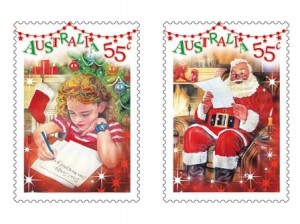 In the weeks leading up to Christmas, Australian children write letters to Father Christmas, or Santa Claus, requesting what they would like for Christmas.
Santa enjoys reading the letters, often ho-hoing over his correspondents’ requests. On receiving these letters Santa makes a list of the presents he will bring to children throughout the world in time for the Christmas festivities. The primary inspiration for Santa Claus is the fourth-century Greek Christian bishop St Nicholas, who was famous for giving gifts to the poor.
The Australian sets of stamps featuring very colourful and traditional images of (read more)
published December 24th, 2010
Australia Post pays tribute to Australia’s first saint
VN:F [1.9.1_1087]
 This stamp issue recognise the canonisation of Australia’s first saint – Mary MacKillop – on 17 October 2010. After her canonisation, Mary MacKillop will be officially known as Saint Mary MacKillop. Mary MacKillop was born in 1842 in Fitzroy, Melbourne to Scottish parents. From an early age Mary had wanted to be a nun.
At just 24 years old she co-founded the Sisters of St Joseph of the Sacred Heart in South Australia and in so doing she made a commitment to live in poverty and dedicate her life to educating poor children, a task she continued until her death in 1909.
Although talks to have her beatified and canonised began (read more)
published October 23rd, 2010
Great new Australian wildlife stamps promote wildlife & collecting
VN:F [1.9.1_1087]
 Stamp Collecting Month 2010 is focused on wildlife caring, introducing children to the important work that an army of volunteers undertake everyday. The release of this issue coincides with Wildlife Awareness Month, which aims to raise public consciousness of wildlife rescue and rehabilitation.
Stamp Collecting Month is all about encouraging children to enjoy the fun of collecting stamps. The message about protecting native animals is conveyed not only through the stamps but also through a miniature sheet. The issue is accompanied by a (read more)
published October 20th, 2010
Australia: Mary of the Cross Stamped Saint
VN:F [1.9.1_1087]
 Australia Post will recognise the canonisation of Australia’s first saint – Blessed Mary MacKillop – by releasing a new commemorative stamp series on October 18. After her canonisation, Mary MacKillop will be officially known as Saint Mary of the Cross (MacKillop). “The canonisation of Blessed Mary MacKillop will be celebrated around the world with services, vigils and pilgrimages.
Australia Post will mark the occasion and recognise the selfless acts of this inspirational heroine in its own way with a special stamp issue.
This is truly history in the making and we’re certain that these stamps will be treasured by Australians for years to come,” said Noel Leahy, Australia Post Philatelic Group Manager. Mary MacKillop was born in 1842 in Fitzroy, Melbourne to Scottish parents. From an (read more)
published September 23rd, 2010
Official WWF stamps by Australia
VN:F [1.9.1_1087]
 The rarest native seabird on Christmas Island, the frigatebird, is featured as part of the World Wide Fund for Nature (WWF) Conservation Stamp Collection.
The frigatebird (Fregata andrewsi) is the rarest endemic seabird on Christmas Island, listed as vulnerable under the Environment Protection and Biodiversity Conservation Act 1999. Considerable areas of the frigatebird’s former breeding habitat have been cleared, and its current breeding areas are now threatened by the invasive Crazy Ant and pollution from past phosphate mining. (read more)
published September 4th, 2010
NEW Girl Guides stamps by Australia
VN:F [1.9.1_1087]
 Girl Guides Australia is celebrating its centenary from September 2009 to February 2011.
Girl Guides evolved from the Scouting movement, founded by Robert Baden-Powell, in the early years of the 20th century. Baden-Powell’s sister Agnes took charge of Girl Guiding in its early years and was followed by Baden-Powell’s wife, Olave.
In Australia, Guiding began as early as 1909, but it wasn’t until 1926 the Federal Council of the Girl Guides Associations of Australia was formed. In 1928 Australia became a foundation member of the newly formed World Association of Girl Guides and (read more)
published September 1st, 2010
First South to North crossing of Australia
VN:F [1.9.1_1087]
 The 150th anniversary of the Burke and Wills expedition, the first South – North crossing of the continent is celebrated with the release of this special stamp issue.
On 20 August 1860, the Burke and Wills expedition left Melbourne for the Gulf of Carpentaria. The explorers hoped to be the first Europeans to cross Australia from the south to the north.
While the explorers reached the Gulf, the expedition ended in tragedy. Physically exhausted from their journey, they hoped to find William Brahe and much needed help and (read more)
published August 10th, 2010
Stamps commemorates 100 years of taxation in Australia
VN:F [1.9.1_1087]
 The Australian Taxation Office (ATO) celebrates its 100th year in 2010 and Australia Post has issued a commemorative stamp to mark this historic occasion.
On 11 November 1910, the Federal Land Tax Branch of the Department of Treasury was established as a central collection office to fund aged care and invalid pensions. This was the forerunner to the ATO. Personal taxation was not introduced until the onset of WWI, which then saw a rapid growth in federal taxation.
The ATO is now responsible for income tax, GSTGSTGoods and Services Tax is a broad based tax on the supply of most goods and services consumed in Australia. The GST rate is 10%. and superannuation as well as (read more)
published August 5th, 2010
Australia Emergency Services stamps 000
VN:F [1.9.1_1087]
 Australia Post has produced a stamp issue to promote the different telephone numbers to call in case of an Emergency. As stamps are becoming increasingly popular, the Government thought that a good way to save lives was by eaturing the numbers on actual postage stamps which people use for their mail or to collect. These stamps are being issued to help raise public awareness about how and when to phone “000″.
Stay focused. Stay relevant. Stay on line. (read more)
published July 23rd, 2010



 Loading...
