150 Anniversary of the death of Johann Nestroy commemorated on Austria’s Stamps
VN:F [1.9.1_1087]
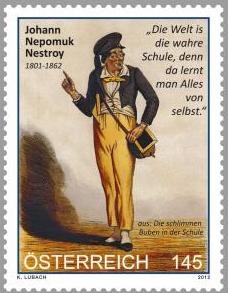
The Austrian writer, actor, singer, playwright and satirist Johann Nepomuk Nestroy (1801 – 1862) was beyond doubt one of the most significant representatives of the old Viennese popular comedy. The motif for the commemorative released on the occasion of the 150th anniversary of his death is a lithograph by Melchior Fritsch dating from 1857, showing Nestroy as Willibald in his burlesque “Die schlimmen Buben in der Schule”.
In addition, the stamp also reproduces the quotation “The world is the true school, since it is there that you learn everything yourself”, from the same work in Nestroy’s transcribed original handwriting Johann Nepomuk Eduard Ambrosius Nestroy, to give him his full name, was born the son of a court and judicial advocate on 7 December 1801 in Vienna.
(read more)
50 years of the Vienna Rapid Transit Railway commemorated on Austria’s stamps
VN:F [1.9.1_1087]
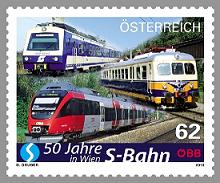
Alongside the Vienna Transport Authority, it is the second element of local public transport within the city. The name S-Bahn was, incidentally, extremely unusual in Vienna for many years although it was occasionally used in the literature, even before 1962. From 1962 to 2005 the term Schnellbahn was used almost exclusively. It was only after the timetable switch for 2005/2006 that the term S-Bahn was officially included in timetable notices and loudspeaker announcements.
(read more)
published December 13th, 2011
Austria’s 150 years of the Alpine Association stamp issue
VN:F [1.9.1_1087]

The purpose of the Association was to spread knowledge about the Alps, promote the love of the Alps and to make access to them easier. The means to this end were to be lectures and publications. In the eyes of many members, however, the academic approach and the centralistic organisation did not achieve the Association’s objective sufficiently. Instead, they wanted practical activities such as the work carried out by the parish priest in the Ötz Valley, a certain Franz Senn. Senn’s idea was of a partnership between city dwellers seeking relaxation and the inhabitants of the mountain regions. Paths and shelters, trained mountain guides, maps and guidebooks were to achieve this purpose.
(read more)
published December 12th, 2011
210th anniversary of the birth of Karl Ritter von Ghega
VN:F [1.9.1_1087]

Exactly on the day of the 210th anniversary of the birth of Karl Ritter von Ghega a new commemorative is being released to celebrate the great Austrian engineer and builder of the Semmering railway. The stamp motif was designed by Ernst Sladek, and shows a portrait of Ghega and the “Kalte Rinne” viaduct, which was built 160 years ago this year.
Born in Venice to parents of Albanian origin, Carlo Ghega was intended to be a naval officer like his father, but it soon became apparent that his mathematical talents were greater than his love of the sea. Having attended the Imperial Military College, he went to study at the University of Padua at the age of 15, obtaining his diploma as an engineer and architect only one year later, and completing his doctorate in mathematics at the age of 17.
(read more)
published December 9th, 2011
Austria’s Motorcycles Stamp Issue
VN:F [1.9.1_1087]

The present commemorative for the “Lohner L 125 1959″ is the attractive continuation of the popular “Motorcycles” series. The stamp shows the legendary scooter from the distant past with which its proud owner could hit the road both casually and elegantly in the 1960s. The “Lohner” was particularly appreciated not only because it was easy to ride, but also for its comfort, which included two luggage compartments. Today, the L 125 enjoys a kind of cult status and always attracts huge interest at exhibitions and trade fairs.
(read more)
published December 8th, 2011
Austria Post Christmas 2011 stamp issue
VN:F [1.9.1_1087]

The Vienna Cathedral and Diocesan Museum was founded in 1933 and is regarded as one of the treasures within the varied Vienna museum scene. Located at Stefansplatz in the 1st District of the city, its permanent collection displays art from over 1000 years, above all works from the cathedral and many other churches in Vienna and Lower Austria. The most valuable possession is beyond doubt the 14th century portrait of the Duke Rudolph IV, regarded as the oldest painted portrait in the western world. Likewise from the 14th century is the work shown on the present Christmas Stamp, the “Birth of Christ”, a painting consisting of seven panel paintings, by an unknown artist.
(read more)
published November 14th, 2011
220th anniversary of the death of Wolfgang Amadeus Mozart commemorated on Austria’s stamp issue
VN:F [1.9.1_1087]
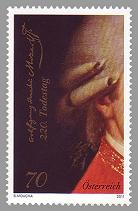
“He was no doubt the most comprehensive musical genius of all ages,” wrote Kurt Pahlen about Wolfgang Amadeus Mozart (“Sinfonie der Welt”, Schweizer Verlagshaus, Zurich 1978). “There was no composer who wrote operas and oratorios, symphonies and serenades, sonatas and songs, quartets and choirs, masses and divertimenti with the same degree of perfection” – an opinion that the Austrian conductor and musicologist no doubt shares with numerous other experts. Following the brilliant Mozart Year 2006 (250th anniversary of his birth), the next anniversary of this great composer is to be celebrated this year: the day of Mozart’s death recurs for the 220th time on 5 December. Good enough reason for a new commemorative, whose contemporary motif was created by the famous stamp artist Sylvia Moucka.
(read more)
published November 8th, 2011
Reopening of the Vienna West BahnhofCity commemorated on Austria Stamps
VN:F [1.9.1_1087]
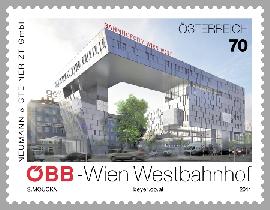
Since the middle of September 2008, Vienna’s Western Railway Station has been undergoing conversion work to create the Vienna West BahnhofCity, the first “railway station city” in Austria, a process that was carried out without operations being interrupted and with special account being taken of monument preservation. The new Western Station is a major milestone of the Austrian Railways “station campaign” in the course of which the most highly frequented stations have been upgraded to the latest technical and architectural standard with a strong focus on customer service.
(read more)
published November 5th, 2011
Trademark stamp issue from Austria Post
VN:F [1.9.1_1087]
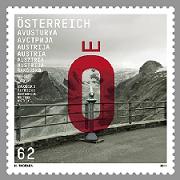
Trademark Austria is an idea competition in the form of a media series to which 20 high-profile visual designers from or living in Austria have been invited. The occasion derives from the impression that the question of Austria’s identity is often unsolved or at least underexposed and that the currently widespread discussion of “Austria as a trademark” is not having much effect. The project plays on the ambiguity of the term, by linking the question of the identity of Austria and its representation to the format of a postage stamp. The results were presented in the Austrian newspaper “Die Presse” between 1 May and 11 September 2011 and assessed by an expert jury.
(read more)
published October 18th, 2011
Austria Post’s New Stamp Issue – Arik Brauer
VN:F [1.9.1_1087]
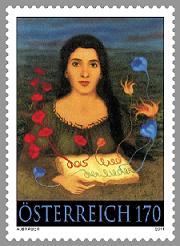
“In my painting, there is no break with so-called reality. I introduce my world of fantasy by devious means, but paintings of the imagination retain a genuine claim to reality. They exist or they may one day exist.” It is in this way that Arik Brauer, an Austrian painter with a worldwide reputation, explains his style of painting. Born on 4 January 1929 in the district of Ottakring in Vienna, the son of a Jewish shoemaker from Lithuania, Arik Brauer is beyond doubt one of the most important exponents of Austrian contemporary art. As one of the main representatives of the Viennese School of Fantastic Realism, Brauer enjoys an excellent international reputation, his works having been displayed in the most famous museums and galleries around the world.
(read more)
published October 10th, 2011
New stamp issue from Austria post – 90 Years of Burgenland
VN:F [1.9.1_1087]
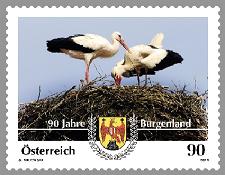
The present commemorative shows a sight typical of this region, a pair of nesting storks, and celebrates 90 years of Burgenland as part of the Republic of Austria.
In 1919, the victors of the First World War decided in the Treaty of St Germain to award German West Hungary to Austria, and in the Treaty of Trianon Hungary was then obliged to abandon this part of its territory. (read more)
published October 4th, 2011



 Loading...
