Unknown Error Surfaces at Stanley Gibbons Public Auction
VN:F [1.9.1_1087]
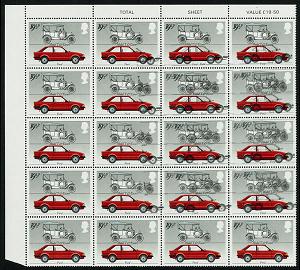
A previously unlisted error affecting twelve of a sheet of twenty,’1982 British Motor Cars 19½p’ was offered at auction by rare stamp dealer Stanley Gibbons last week, achieving £10,925.
A new error has been discovered this week by auctioneers at Stanley Gibbons. A sheet of twenty 1982 British Motor Cars 19½p featuring a previously unrecorded ‘double grey’ printing error has been sold for £10,925; nearly three thousand times its original face value.
(read more)
published December 27th, 2011
US Post 44cent stamp mix up
VN:F [1.9.1_1087]

There has been a mix up with the 44 cent stamp which was issued back in December 10. The stamp depicts a replica of the famed statue of liberty in the kitschy Nevada gambling capital rather than the weathered and revered original in the Big Apple (New York).
The postal service printed three billion of the first-class stamps and despite the error, they will continue to sell them.
A stamp collector discovered the mix-up after noting discrepancies between the stamp image and the copper original.
(read more)
published April 17th, 2011
Isle of Man new Pope’s visit stamps have wrong information
VN:F [1.9.1_1087]
The stamps issued by Isle of Man commemorating the visit of Pope Benedict XVI’s visit to Britian next month (September) have printed the wrong location name due to a recent change in venue for the Papal Mass by the Roman Catholic Authorities.
The initial plans were for the Pope to beatify Cardianl Newman at Coventry Airport but due to the large number of expected visitors to the beatification the venue has been changed to Coventry Airport.
The sheets of stamps published by the Isle of Man with the wrong information had already been sent to dealers worldwide in advance of its issue date and (read more)
published August 28th, 2010
Who was Madame Joseph?
VN:F [1.9.1_1087]
From Wikipedia, the free encyclopedia
Madame Joseph (c.1900 – after late 1940s) [1] was a stamp dealer active in London in the early part of the twentieth century and who has since been revealed to be a major supplier of stamps with forged cancels. In conjunction with her successors over 400 fake cancels were used dated up to 1967.
Forgery business
Known as Madame Joseph because she went by the surname Joseph and was possibly French or Belgian[1] (her first name is unknown), Joseph, her accomplices and successors used fake handstamps to turn common unused stamps into more valuable used ones. Some fake cachets, cork cancels, surcharges and overprints were also used. Over 400 fake cancels were used, mainly for British Commonwealth stamps and it is believed that there are probably additional fake cancels that have yet to be discovered. The wooden cancels are thought to have been made in France while the zincograph copper plated implements may have been created originally for use as book or catalogue illustrations.[1][2]
According to Brian Cartwright there was also a Monsieur Joseph,[1] however, even less is known about him than his wife and as Madame Joseph was normally responsible for serving customers, the business and fakes have come to be attributed to her. The exact extent of Monsieur Joseph’s involvement in the business has yet to be determined and may be more extensive than previously thought.
The trade was very (read more)
published June 19th, 2010



 Loading...
