Estonia’s 2011 Europa Issue
VN:F [1.9.1_1087]
 Estonia is extremely rich in forests – nearly half the territory of the country is covered with forests. Estonian forests belong to the mixed forests zone and the most widespread forest type is where evergreen conifers dominate, but there are also deciduous forests.
Dozens of domestic species of trees and shrubs grow in the forests, the most common tree being the pine, followed by the birch and the spruce.
The biggest forests in the country lie in the north eastern and central parts of Estonia. There are primeval virgin forests, sustainably managed forests as well as specially developed holiday forests.
(read more)
published July 14th, 2011
The Struve Geodetic Arc by Estonia
VN:F [1.9.1_1087]
 The Struve Geodetic Arc is a chain of survey triangulations stretching from the Black Sea to Norway’ northern coast on the initiative of Friedrich Georg Wilhelm Struve (1793-1864) for the measurement of the shape and size of the planet Earth. The measurement of the arc is an exceptional example of different countries scientists’ and monarchs’ cooperation with a scientific aim. The length of the arc is 2,820 km. When the arc was created and more than a century later it was the longest measured meridian arc. It passes through the territory of today’s Norway, Sweden, Finland, Russia, Estonia, Latvia, Lithuania, Belarus, Moldova and Ukraine.
(read more)
published July 13th, 2011
75 Years of Estonia’s Vergi Lighthouse
VN:F [1.9.1_1087]
 The village in the eastern part of the Vergi Peninsula was first mentioned in 1539; from 1582 there is a concrete reference to the Vergi Port. In the late 19th and early 20th century Vergi was one of the biggest fishing villages on the North Estonian coast, particularly known as the best eel fishing place.
In the 1920s it served as a wintering place for small ships and it also had a shipbuilding industry. In 1924 an automatic light pyramidal lattice frame light beacon covered with iron plating was put up on a large coastal reef next to Vergi Port.
(read more)
published July 12th, 2011
Estonia’s Bird of the Year: Barn Swallow
VN:F [1.9.1_1087]
 The barn swallow (Hirundo rustica) is a passerine with blackish blue upperparts, off-white underparts, rufous forehead, chin and throat and a deeply forked tail, of which 100,000 to 200,000 pairs live in Estonia. It mainly nests in man-made structures, such as stables, attics and under the eaves of buildings, where it builds a nest of mud, clay, stalks and saliva.
The Estonian Ornithological Society picked the barn swallow for bird of the year 2011. On the one hand, the Society wanted to mark its round 90th anniversary with the image of the bird in its logo.
On the other hand the rapidly changing world and living environment makes us feel concern about the welfare of our national bird. The population of the barn swallow is falling due to the contraction of suitable nesting places and major changes in European agriculture.
(read more)
published June 10th, 2011
Estonia’s Stamp Issue of the Folk Costumes
VN:F [1.9.1_1087]
 Estonia Folk Costumes. Harju County – Rapla
Clothes of more or less the same type as elsewhere in North Estonia were worn in Harju County, although wide differences can be found particularly in the colours and decorations of women’s dress. From Jõelähtme near Tallinn a girl and a woman from the first half or the middle of the 19th century have been reproduced on the stamp. The girl’s headgear is a so-called eared wreath and a wide red band decorates her green-striped skirt.
The girl’s sleeve embroidery is rather simple, but the sleeves of the married woman who sports an embroidered apron are decorated with lavish wide embroidery. She wears a pot hat lined with silk. Gradually spreading, such hats crowded out the earlier traditional women’s headgear. The Rapla woman on the other stamp also wears a hat.
(read more)
Estonia Stamp Issue Commemorates the Estonian Figure, Friedebert Tuglas
VN:F [1.9.1_1087]
 Friedebert Tuglas (Mihkelson until 1923, b. 2 March 1886 at Ahja , d. 15 April 1971 in Tallinn) was a writer, critic and translator, who had a leading role in the literary life of the country. He took part in the Russian Revolution of 1905 and since 1906 lived as a political refugee in Finland, Paris, St. Petersburg, Germany, Belgium and Switzerland; since 1917 in Tartu and from 1944 in Tallinn. He was founder of the Siuru literary society, instituted the journals Odamees, Ilo, Tarapita and Looming, was chairman of the Estonian Literary Society and member of several foreign literary and cultural societies and councils. He wrote psychologically tense impressionistic and neo-Romanticist prose, and thanks to his critical writings was one of the most influential trendsetters of new prose. In 1970 he established the Estonian Union of Writers’ short story prize. His house-museum in Tallinn (est. 1971) is now, since 1993, the Under and Tuglas Literature Centre.
(read more)
Peony Flower Issue by Estonia
VN:F [1.9.1_1087]
 The peony or paeony is a name for plants in the genus Paeonia, the only genus in the flowering plants family Paeoniaceae. They are native to southern Europe, East Asia and western North America where they grow in grasslands, brushwoods and in valleys between mountains. It is a flowering plant appreciated because of its frost-hardiness, longevity and stamina, its beautiful and lasting leafage, height of the shrub, size and beauty of the flower as well as the diversity of its shapes and colours, its long period of blossoming and durability as a cut flower. They have meaty, tuberous roots called bulblets and large seeds in erect follicles.
(read more)
Chinese New Year Stamps- Year of the Hare, Issued by Estonia
VN:F [1.9.1_1087]
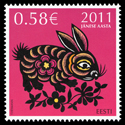 According to the Chinese zodiac calendar the new year this year falls on February 3, ushering in the Year of the Hare. The Hare (or the Rabbit) is regarded as the most propitious among the twelve signs of the zodiac because it is a symbol of longevity. People born in the Year of the Rabbit are articulate, talented, and ambitious. They are virtuous, reserved, and have excellent taste.
(read more)
published April 27th, 2011
Estonia Stamp Issue Commemorates the Estonian Figure, Villem Reiman
VN:F [1.9.1_1087]
 Villem Reiman (1861-1917) was an outstanding Estonian public figure – historian, journalist, ardent speaker for the idea of independence, promoter of temperance and the establishment of societies, honorary alumnus of the Estonian Student Society, originator of the fundamental principles of the Estonian Evangelical Lutheran Church, paver of the way to independence and its cultural development.
(read more)
published April 22nd, 2011
Estonia joins the Euro
VN:F [1.9.1_1087]
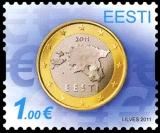 From the 1st of January 2002 a common currency, the euro, was introduced in twelve countries of the European Union. It was possible to make bank transfers in euros already starting from 1999 but the seven euro banknotes and eight coins came into use three years later.
The euro denomination appeared parallel with the kroon on an Estonian postage stamp for the first time in 1999 when the stamp dedicated to the 50th anniversary of the Council of Europe was issued. In the period from 2006 to 2010 the face value on Estonian stamps was shown in (read more)
published January 5th, 2011
The famous Estonian manor halls on stamps
VN:F [1.9.1_1087]
The Suuremõisa, originally Pühhalep (Pühalepa), Manor on Hiiumaa Island was established in about the 15th century as an economic unit of the Livonian Order. After passing into the ownership of the King of Sweden, it belonged to different noblemen’s families and then to the Russian Imperial Crown, until Countess Ebba Margaretha von Stenbock bought it in 1755 and had the present two-storied baroque mansion with a high basement and a mansard built (the main building with mansard roof was completed in 1750 and the wings and a outhouses in 1772).
In 1879, the manor passed into the ownership of the Ungern-Sternbergs, from whom the property was alienated under the Republic of Estonia Land Reform Act in 1919. Suuremõisa is regarded as the most stylish manor ensemble in Estonia. The manor had numerous outhouses (some of them destroyed) and a large park at the back of the house.
The manor hall of 64 rooms has stucco decorations, ceiling pieces, an arching main staircase in two flights, a (read more)
published September 7th, 2010



 Loading...
