


Check out the Joint Issue of Switzerland and Russia on WOPA Stamps!
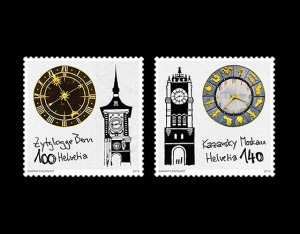
Russia and Switzerland have maintained diplomatic relations for 200 years. During the Second World War, those relations were briefly severed, but were restored after the war ended and have been stable ever since. In recent decades, diplomatic relations have taken on a different dimension, and can now be described as a long-term partnership. The two countries are forging ever closer ties and contact between Swiss and Russian people is steadily increasing, thanks to the ever-growing number of reciprocal arrange- ments in the cultural, higher education, sport and tourism spheres. To mark the milestone anniversary of these ties, a joint issue is being published by Swit- zerland and Russia – each bearing a famous national landmark.
Everybody is familiar with Berne’s clock tower: the federal capital’s defining land- mark and a tourist magnet. When it was erected at the start of the 13th century, as a fortified tower, the building marked the western edge of the city of Berne. As the city grew, the tower moved closer to the centre, where it became redundant as a fortification. During the 15th century, it was used as a prison and subsequently as a clock tower – Zytglogge – and was re- built from Berne sandstone. From then on, its clock dictated the time for the entire city and became the point of refer- ence for measuring the travel times indi- cated on the hour stones along the cantonal roads.
In the 16th century, the tower gained its present-day height and a new clock. Be- neath this, in the archway, the edicts and ordinances of the City of Berne were posted and, from the 18th century on- wards, the measures of length were af-fixed for official inspection. When the tower underwent further alterations in 1770 and 1771, it was incorporated fully in the cityscape and adapted to its envi- ronment with the addition of baroque embellishments.
The Zytglogge tower owes its national and international fame not only to its eventful history, but also to its special ca- rillon, the ring of bears, lions, a rooster and the god of time, Chronos.
The Kazansky tower depicted on the Russian special stamp may be recog- nisable from afar but it isn’t the tower itself that is famous … In fact, the tower is the most imposing feature of Kazan- sky station, one of Moscow’s eight largest stations. The station was built in 1862 and, initially, was nothing more than a small timber building without a waiting room or platform. Two years later, the wooden building was dis- mantled and, in its place, a stone sta- tion building was erected.
The new station building fell short of increasingly stringent requirements; it was too small and of little architec- tural merit. When the railway line was extended further eastwards to the large Volga city of Kazansky – which gave the station its name – and passen- ger numbers swelled accordingly, the station had to be expanded yet again. After various makeshift solutions and lengthy debate, in 1918 work com- menced on the construction of the present-day station building, follow- ing the nationalization of the railways. It was a huge undertaking and the sta- tion was not fully completed until 1940. Even once the building was fi- nally complete, it underwent further expansion and upgrading work which had been included in the original con- struction plans but had not been im- plemented. Among the further addi- tions were the clock tower, the under- ground terminal building for local public transport and the direct access to the underground.
Source: WOPA Stamps
published July 2nd, 2014
 Loading...
