


Ireland’s New Issue – Viking Heritage!
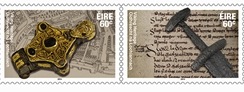
On April 24th, 2014, An Post issued two Viking Heritage stamps in honour of Ireland’s rich Viking history and the enormous influence the Vikings had on Ireland.
The first recorded Viking raids in Irish history occurred in 795 when Vikings, possibly from Norway, attacked and looted the islands of Rathlin off the coast of Antrim and Lambay by Dublin. These early raids interrupted the golden age of Christian Irish culture and began 200 years of intermittent warfare, with waves of Viking raiders plundering monasteries and towns throughout Ireland. The Vikings travelled all around the coast of Ireland including raids on the Skellig Islands off the coast of County Kerry.
Very importantly for Ireland, the Vikings established ports at Dublin, Waterford, Wexford, Cork and Limerick which are some of our biggest port cities today
However, the Vikings were not favoured by the Irish Celtic Chieftains and things came to a head on Good Friday in 1014 at the Battle of Clontarf. There, Brian Boru, the High King of Munster was opposed by the Vikings from Dublin and the King of Leinster. Viking Chieftain, Brodir, killed King Brian that day and in turn ended the Viking and Irish Celtic battle. The Vikings held onto power throughout Ireland and they continued to work and trade until the arrival of the Anglo-Normans in 1169.
We know so much about Viking influence in Ireland from the remains of their early settlements which have been found at Wood Quay, Christchurch Place and the Temple Bar area of Dublin. In Wood Quay, the remains of about 200 houses from the 10th and 11th centuries were uncovered. During archaeological investigations in Waterford in 2002, excavations uncovered numerous objects, including silver ingots, weights and a Viking burial site with weapons.
These commemorative Viking Heritage stamps were designed by Ger Garland. One stamp features a sword, similar to those used in the Battle of Clontarf while the second features the Waterford Kite Brooch, Ireland’s finest piece of early 12th century secular metalwork.
Source: Ireland Post
published June 30th, 2014
 Loading...
