


The artist who designed 871 stamps for 45 countries in 25 years
EXCLUSIVE STORY
Mr John Batchelor is probably the person who has designed the most ever stamps (by far) in the history of postage stamps. He loves his work and enjoys working with people in the business all of whom seem to be as enthusiastic as himself. Every new commission is a new thrill to John always requiring new energy and planning. The team of www.worldstampnews.com is delighted to bring you such an exclusive story of the man who has done so much for the philatelic world
Its amazing that the majority of us reading this article will probably have more than one stamp illustrated by him in our colelction without even knowing….
John Batchelor feels that his career started during the Battle of Britain because having watched a dogfight between 2 Me.109 fighters and a British Hurricane at low altitude over Leigh-on-Sea, Essex. The Hurricane caught fire and crashed near Canvey Island. An hour later he did a pencil sketch of the battle which his mother ironed flat and dated.
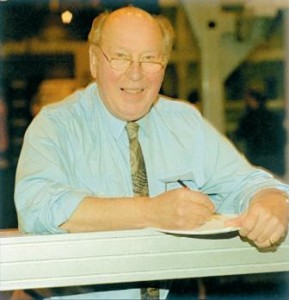 (picture by Jack Noble) This illustration opens the lecture he gives to various art and technical organisations in the USA and Europe. Later, he was refused entry to art school and was told that , “Nobody would ever be able to earn a living doing illustrations of ships, aircraft and other technical things”. He was told to do something else as he could never become an artist of any sort.
During the rest of the war his mother collected and dated 72 of his illustrations and it was the sight of these in a brown folder
that made him determined to learn the business. Choosing antique pistols and armour to illustrate he quickly became familiar with the medium of gouache paint. Scores of illustrations later, pistols, armour, aircraft, cars, tanks, locomotives, ships of every age, he started to send samples to magazines and received occasional commissions. In 1962 he could wait no longer and plunged into the world of being a freelance technical artist.
Arriving in London on his first day with no contacts and certainly little money he walked into the offices of the boy’s paper Eagle, just about the most famous of boy’s reading. Having had a fascination for the cutaway illustrations in aircraft magazines during and after WWII he told the editor that these were what he could do and came away with commissions for 6 of these and a 56 week series on ‘famous guns’, the illustrated series of the guns owned and used by, for instance, Billy the Kid and General George Custer. One thing led to another and after illustrating Purnell’s history of the second world war (1163 illutrations) he originated the idea for a series of heavily illustrated books called ‘History of World War Specials’ which went on to sell nearly 20 million copies in 47 countries.
Other contacts, other publishers in Europe and the USA made for much work but an idea came to him in a split second. Britain should have a set of postage stamps to mark the 50th anniversary of the first flight of the Spitfire. Having never done anything for the world of postage stamps he produced some finished colour ‘roughs’ and sent them with a letter to the British post office design centre in London. It was mid 1985 and the date of the first flight anniversary was March 5th 1986. Time to do the job.
The post office design department never did acknowledge his letter or the fact that I had produced the miniatures, you see, he knew so little about stamp design and production that he thought one had to design stamps at final stamp size!!! JB gave up
on the idea when suddenly a company called Philatelists called up to tell me that they had got hold of his letter and roughs for the Spitfire stamp idea and asked if he would care to produce the works. He jumped at the idea never dreaming that this was to be the start of a completely new part to his career. Having been instructed in the usual procedure, he produced new artwork pencil roughs, at 4 times height and width of the finished stamps, and having submitted these, set about the finished artwork.
On the day of the actual anniversary he and a representative of the stamp production company arrived at Eastleigh Southampton) airport along with about 100 ex Spitfire pilots. They went round showing a sample FDC and stamps and a lot of interest was raised. The country issuing the stamps was the little island of Nevis who with St. Kitts, collected money in the streets during WWII to buy a Spitfire and then a second one. The covers ordered were being cancelled in Nevis on that day and would be flown out that evening back to England. The kind people at the philatelic bureau in Nevis were kind enough to put a cancellation stamp on each of his pencil roughs and return them. He also has the sample FDC and stamps shown around on the 5th of March gathering signed by the pilots of each of the Spitfires shown on the stamps. Jeffery Quill, the test pilot who flew the protoype and Dr Gordon Mitchell, son of the designer, R.G. Mitchell are amongst those who signed the FDC.
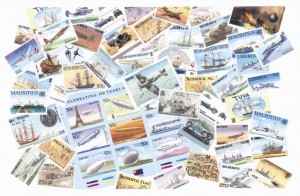
Now, 25 years later, JB is working on stamps to mark the 75th anniversary of the first flight of the Spitfire for Gibraltar. This icon of all that was best of Britain at a time when the country was alone struggling to stay free from the nightmare of the Nazi scourge makes JB proud to be involved in such a project. In the 25 years since that first set of stamps was produced he has worked on the production of 871 postage stamps for 45 different countries.
He worked for Intergovernmental Philatelic Bureau in New York and was then contacted by Crown Agents Stamp Bureau for whom he produced the largest proportion of his total output of stamps.
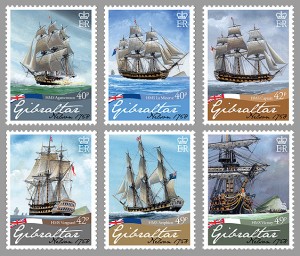
Specialising is technical subjects, especially aircraft and ships, then again, especially sailing ships he has had to do a lot of research. Apart from postage stamps, JB has illustrated several sets of volumes on the history of ships and aviation and has, therefore, produced hundreds illustrations all of which have had to be technically accurate. His personal library consists of over 2000 technical books and manuals and 3000 files of technical information. Always most helpful , he is in close contact with museums in many countries for whom he provides as much information as he gets from them. His personal knowledge of the second world war was invaluable when producing many commemorative stamps to mark the 50th anniversary of ‘D’ Day.
Again his knowledge of the history of aviation came to his aid when producing stamps to mark the 100th anniversary of the Wright bros first flight – not the 100th of the first flight, that was 1847 in Chard, Somerset. A job that took up much time was the series of 60 stamps marking the centenary of the motor car, a job enjoyed to the full.
Although of retirement age, JB still works as near full time as commissions allow. Make sure to visit his website www.johnbatchelor.com
The team at www.worldstampnews.com look forward to seeing another 871 issues in the next 25 years and we send John their very best wishes for the future
published May 16th, 2010
 Loading...
