


Israel Post – The Hebrew Language
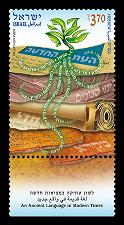
The Israeli government has decided to honor the Hebrew language by issuing a stamp that highlights Hebrew’s uniqueness: its continued existence even after it ceased to be spoken, the treasures that were added to its vocabulary throughout the ages, and its modern revival as the everyday language of Israel.
Hebrew is an ancient language that was spoken over the course of many centuries in the Land of Israel and subsequently preserved by Jews throughout the Diaspora as a medium of cultural and religious expression. With the rise of Zionism and the State of Israel, the Hebrew language was revived as a spoken tongue and enriched with many new terms and constructions to reflect the reality of modern life. Modern Hebrew draws on all of the previous layers of the language’s history. Ancient words are ascribed new meanings and new words are created following patterns and paradigms native to the ancient tongue. It has also absorbed some modern terms from other languages, as happens with all languages.
Biblical Hebrew provided the most basic words, such as adam (man), yom (day) and maftea -h (key), as well as a lot of abstract terms such as a-hava (brotherhood), deror (liberty) and emet (truth).
Mishnaic Hebrew is the Hebrew used in rabbinic writings such as the Mishnah (a legal code) and books of biblical interpretation. It too was originally a spoken language, a dialect somewhat different from, and later than, standard biblical Hebew. From it came a number of new coinages, some of them deriving from Hebrew’s daily contact with Aramaic, another language of the region. It added to Hebrew such terms as ilan (tree), -hazar (returned) – different from their equivalents in biblical Hebrew – as well as words that are unattested in biblical Hebrew, such as kavveret (beehive) and gesher (bridge).
Medieval Hebrew, a written language that flourished among Jews in both Muslim and Christian lands, added such words as ekhut (quality), as well as a number of terms borrowed directly from Arabic, such as ta’arikh (date). New words created in Medieval Hebrew poetry are also in use in Modern Hebrew, such as ma’as (action, deed) and miv -han (test).
Modern Period – Starting with the rise of modern Hebrew literature in the mid-18th century onward, and especially since Hebrew’s revival as a spoken tongue in the early 20th century, the language has had to face the continual challenge of preserving its ancient spirit while adapting to modernity. New terms to fit modern society and technology had to be wrested from old roots and paradigms. Some of these innovations were created by individuals on their own initiative, while others originated thanks to institutions, in particular the Hebrew Language Committee and its successor, the Academy of the Hebrew Language. The Academy established the Historical Dictionary Project, which seeks to preserve and catalogue treasures of Hebrew throughout the ages.
The Modern Hebrew language is still a work in progress, a vigorous new idiom growing out of ancient roots.
The Academy of the Hebrew Language
Biblical Hebrew is represented by an ostracon inscribed with the “field worker’s letter” discovered at the ancient Mesad -Hashavyahu fortress, written in ancient Hebrew script and dating from the 7th century BCE. The seedling’s root that derives from it (third from left) features the words: mishpa-ha (family), a-hava (brotherhood), nefesh (soul, spirit), maftea -h (key), tsedek (justice), merkava (chariot), deror (liberty), kazav (untruth), ra’am (thunder) and kefir (lion cub).
Medieval Hebrew is represented by codices bound in typical bindings of the period. The root rising out of them (second from left) features the words: ekhut (quality), kammut (quantity), shelemut (completeness), ta’arikh (date), ofek (horizon), koter (diameter), la -han (melody), hashva’a (comparison) and miv-han (test).
Mishnaic Hebrew is represented by a parchment scroll featuring a passage of the Mishnah, reflecting the Hebrew that was spoken in Eretz Israel in the 1st and 2nd centuries CE. The seedling’s root that draws from this level of the language (represented by the parchment) rises to the right of the biblical root and features the words: kneset (assembly, parliament), ilan (tree), gesher (bridge), tinok (child, baby), lakoa –h (customer), kavveret (beehive) and -hotem (nose).
Modern Hebrew is represented by an electronic reading device that serves as today’s alternative to the book. The roots deriving from it (on the far left and right) feature new words: -havaya (experience), -hamtsan (oxygen), misron (text message, SMS), adivut (courtesy), monit (taxi); ma-hshev (computer), taklitor (CD), midgannim (cereals), mir’ash (sensation); nevita (germination) – the word that appears on the stem.
The phrase at the bottom of the stamp, “Ancient Language in a New Reality” was coined by Professor Ze’ev Ben–Hayyim, a prominent Hebrew linguist and one of the founders of the Academy of the Hebrew Language, serving as its president from 1973 to 1980. This phrase is taken from the title of his 1953 article, in which he discussed the special character of Modern Hebrew. According to Ben–Hayyim, “the unique characteristic of Hebrew is not changes in meanings of words (as is typical of every language)… but rather its uniqueness lies in the fact that nothing was lost… thus our language has… multiple layers alongside each another and not atop one another as in the case of other languages that have continued to exist over time”.
Stamp Description
The center of the stamp features a seedling whose leaves spell the word Ivrit (Hebrew). Its roots consist of all the earlier layers of our language found in four principal sources – the Bible, rabbinic literature, medieval writings and Modern Hebrew.
Technical Details: Issue: February 2011 Design: David Ben-Hador Stamp Size: 50 mm x 36 mm Plate no: 825 (one phosphor Sheet of 10 stamps, Tabs: 5 Printers: Joh. Enschede, The Netherlands Method of printing: Offsetpublished January 31st, 2011
 Loading...
